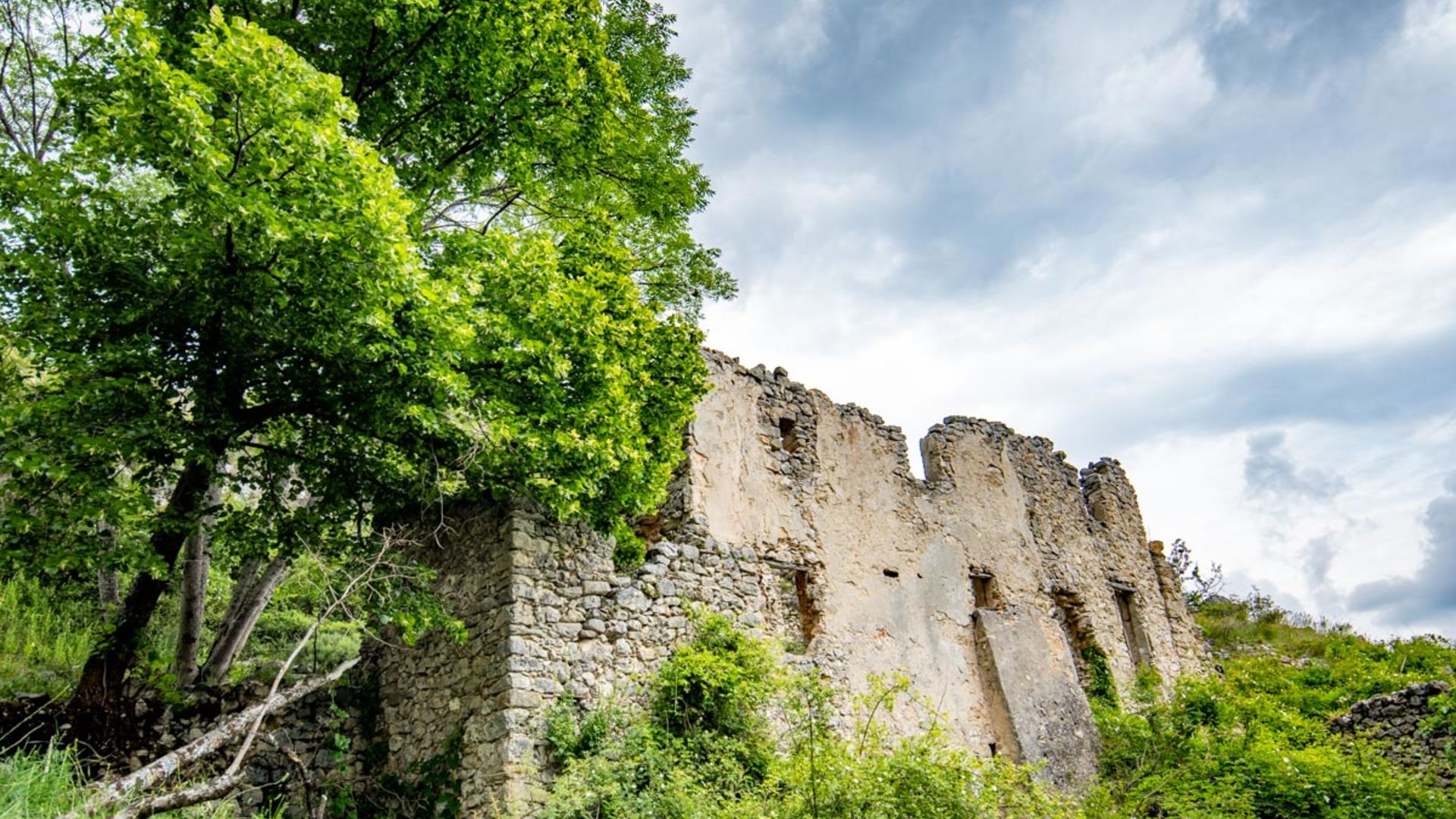
The abandoned village of Châteauneuf-les-Moustiers
That day, the weather wasn't kind to us, the sky was threatening but it didn't discourage us. A good breakfast at the Clos de Barbey campsite, time to prepare and pack our sandwiches and the whole family is ready for a discovery trip: the abandoned village of Châteauneuf-Lès-Moustier in the Alpes de Haute-Provence. The story of Châteauneuf-Lès-Moustier had caught our attention a few days earlier as we prepared for our trip to the Verdon. How could this village, now lost in the middle of nowhere, have died out and gone from 600 inhabitants in the early 19th century to 0 when the last inhabitant, a widow, left in 1932?
Aux alentours
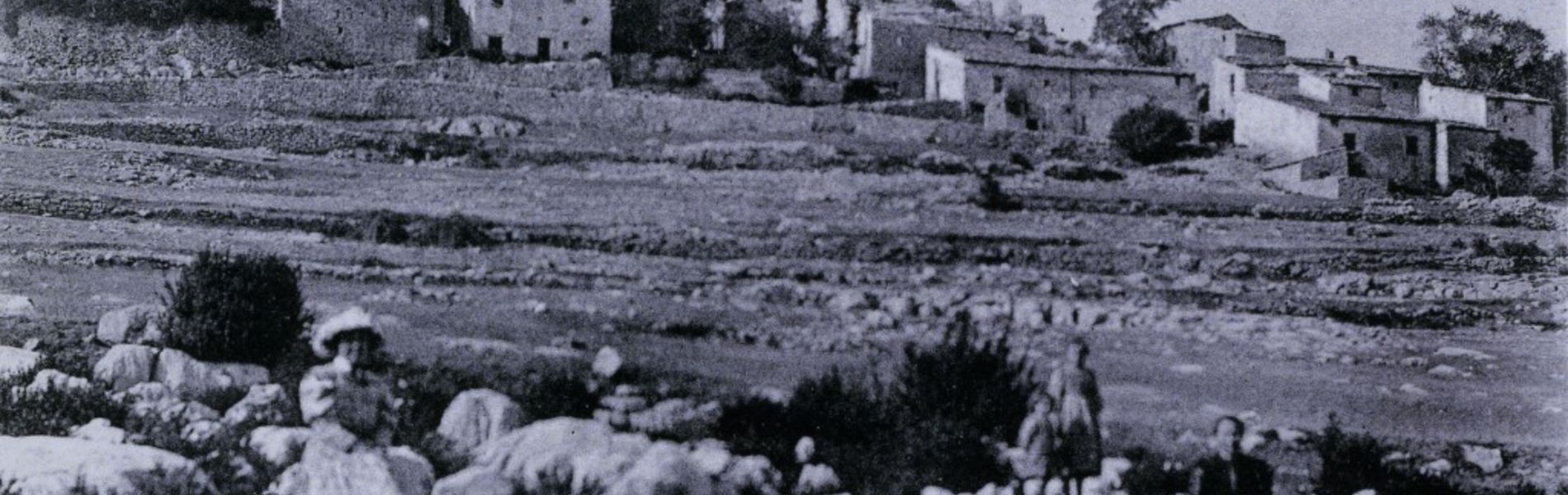
The village of Châteauneuf-les-Moustiers
Perched at an altitude of over 1,000 metres, the village dominated by its church and castle for centuries is now in ruins, a shaky reminder of the region's rural past at the beginning of the 20th century. Life was hard here and many of the inhabitants fled before the First World War struck the final blow, taking 19 young men with it.
To get to the village, take the route des crêtes overlooking the famous Gorges du Verdon, pass the village of La Palud-sur-Verdon and follow a small winding road, the D123, for just over 5km.
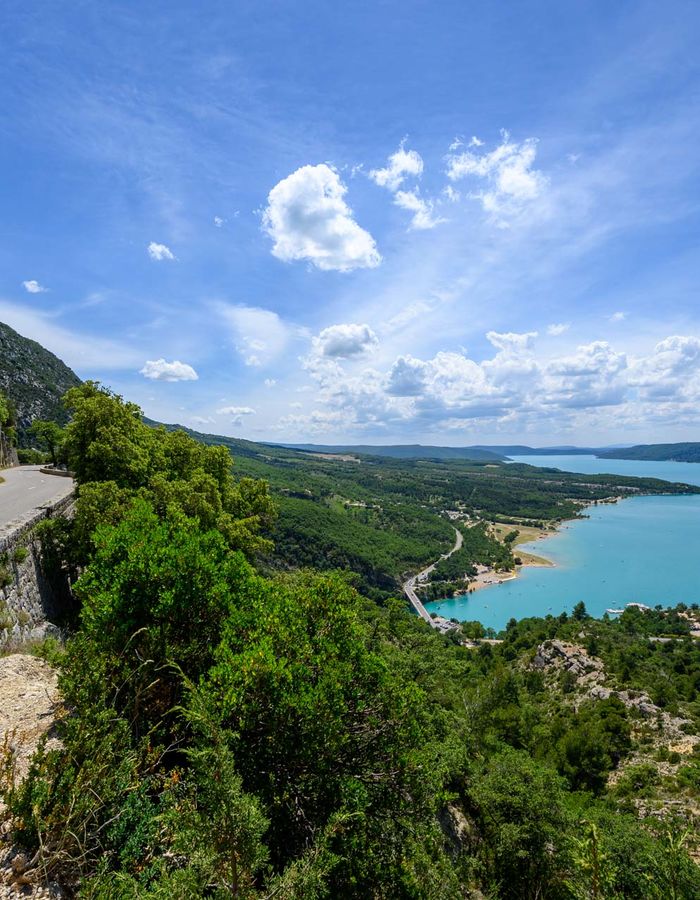
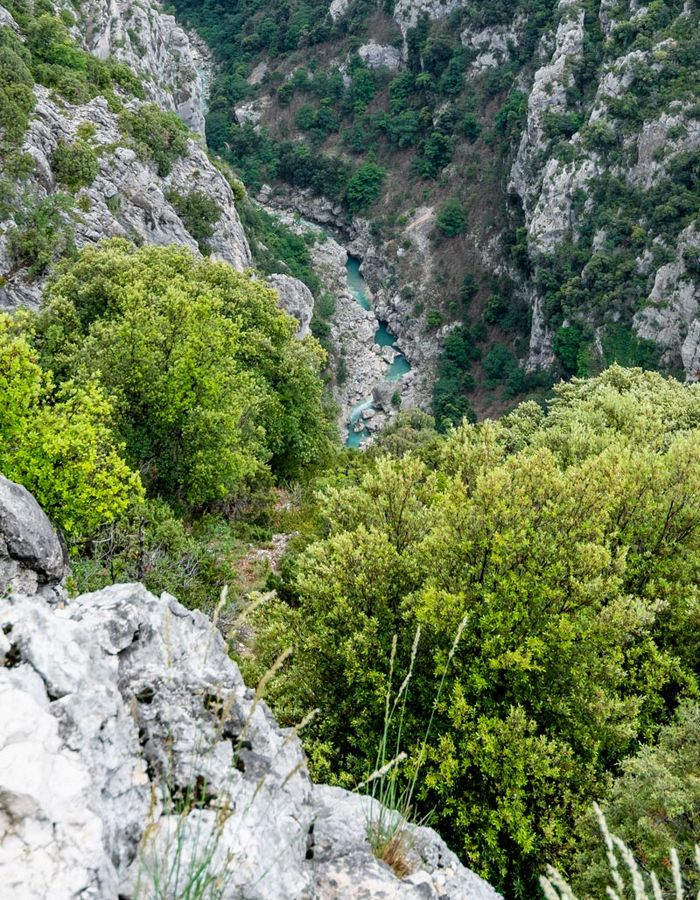
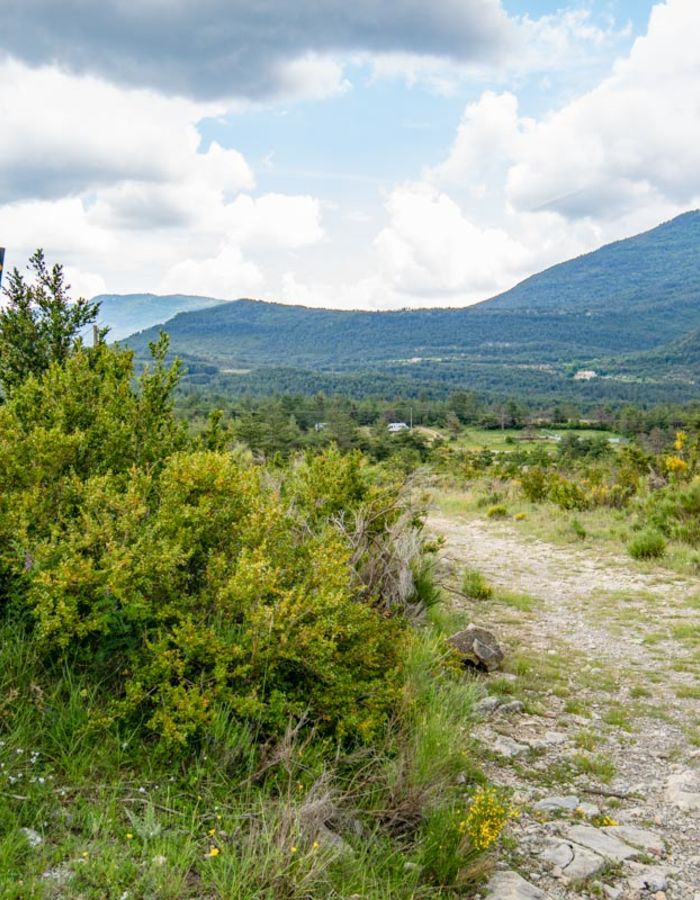
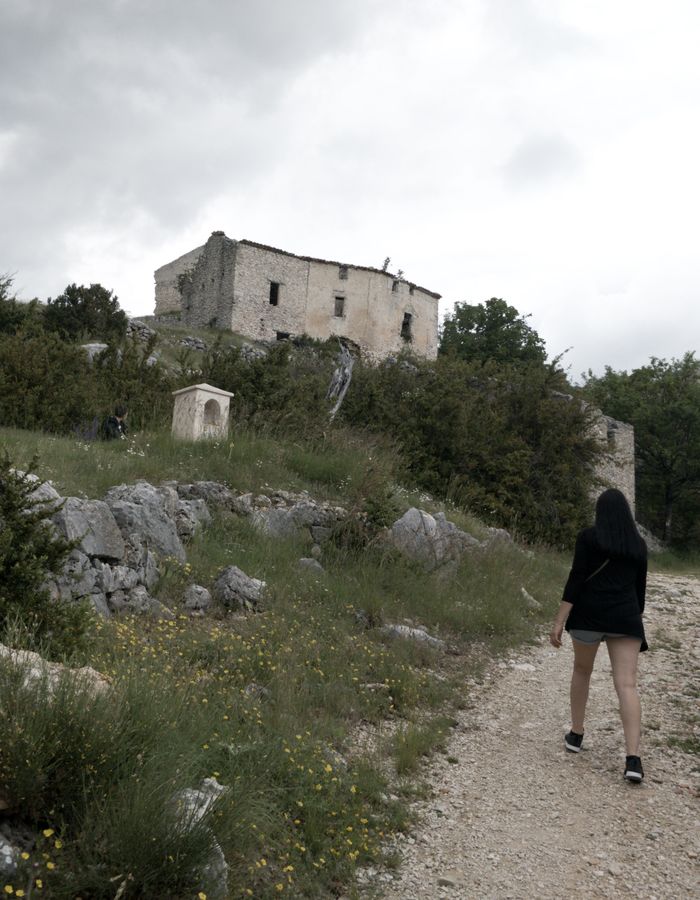
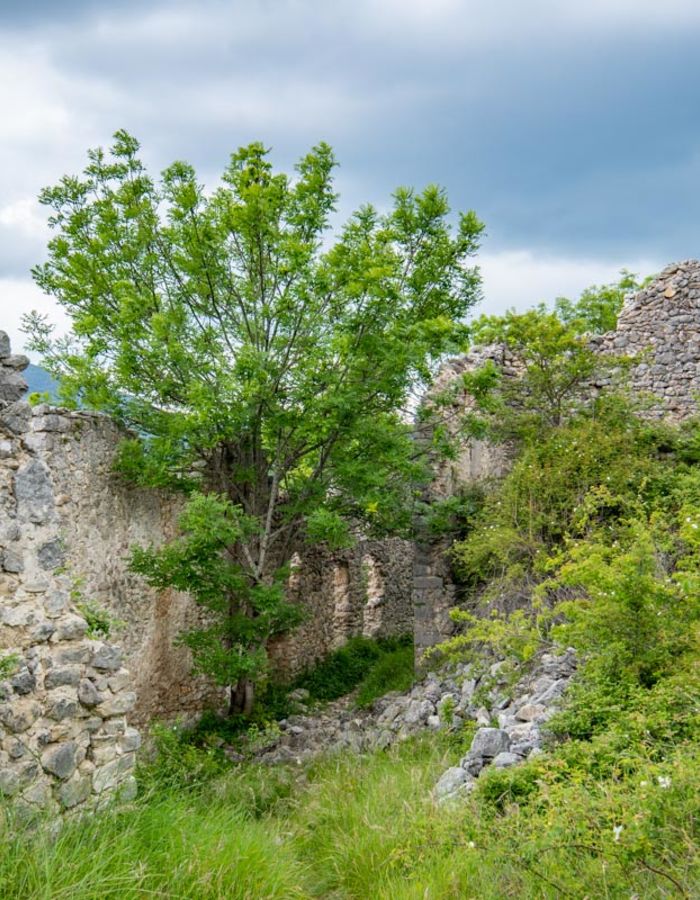
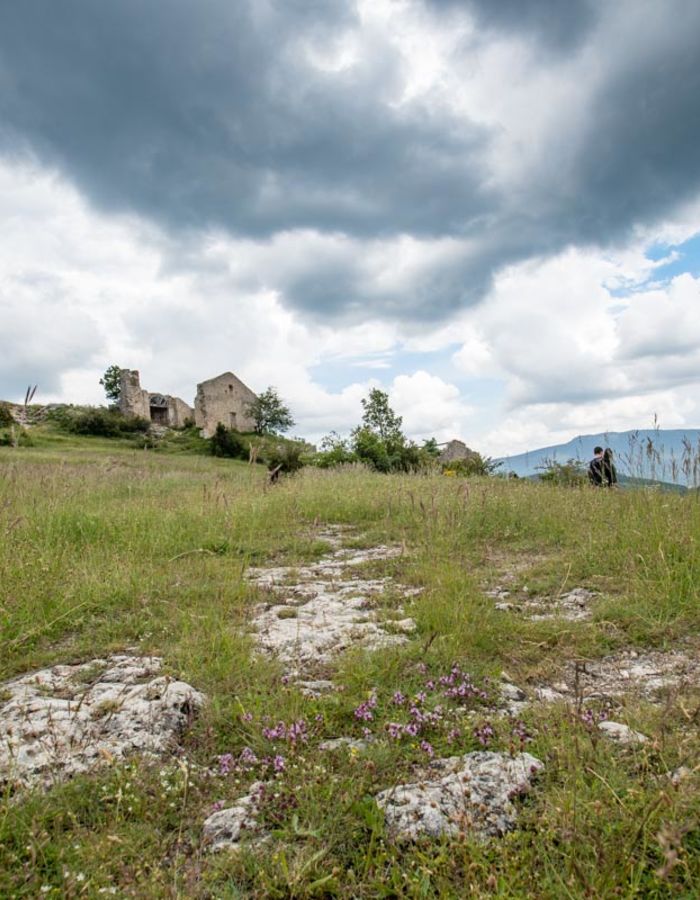
Drowned in abundant vegetation, in stark contrast to the images on old postcards, the village still discreetly dominates the valley that the fortress closed off in the Middle Ages. There is a car park at the foot of the hill, still surrounded by a few farms. The path, which is not very difficult, is the one that the villagers used every day to return home after long days working in the fields. Bordered by a few hundred-year-old trees, the path gently reveals the first sections of wall of the old village. A few drops of rain remind us that the storm is not far off.
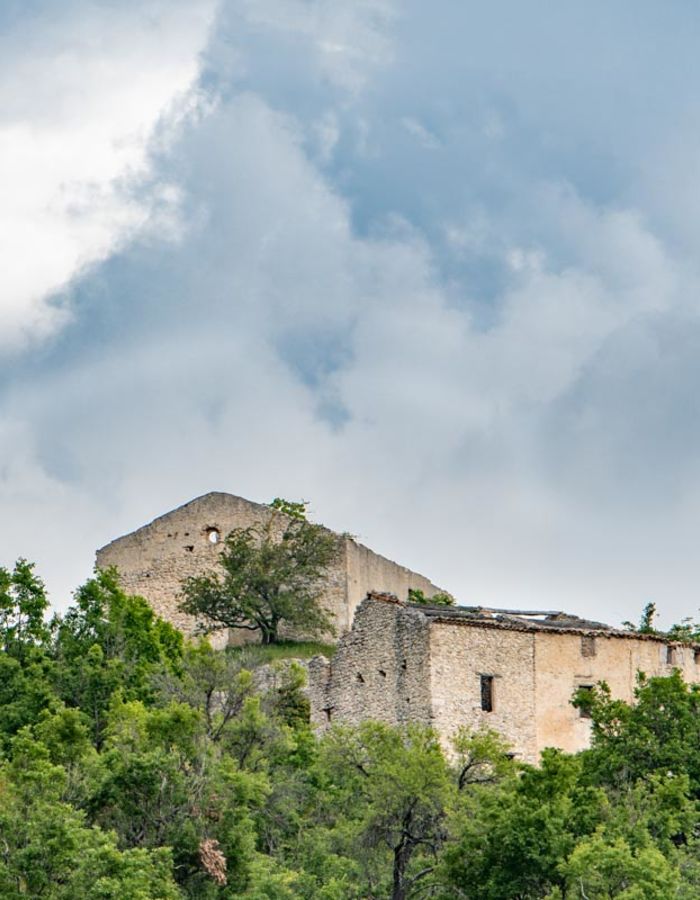
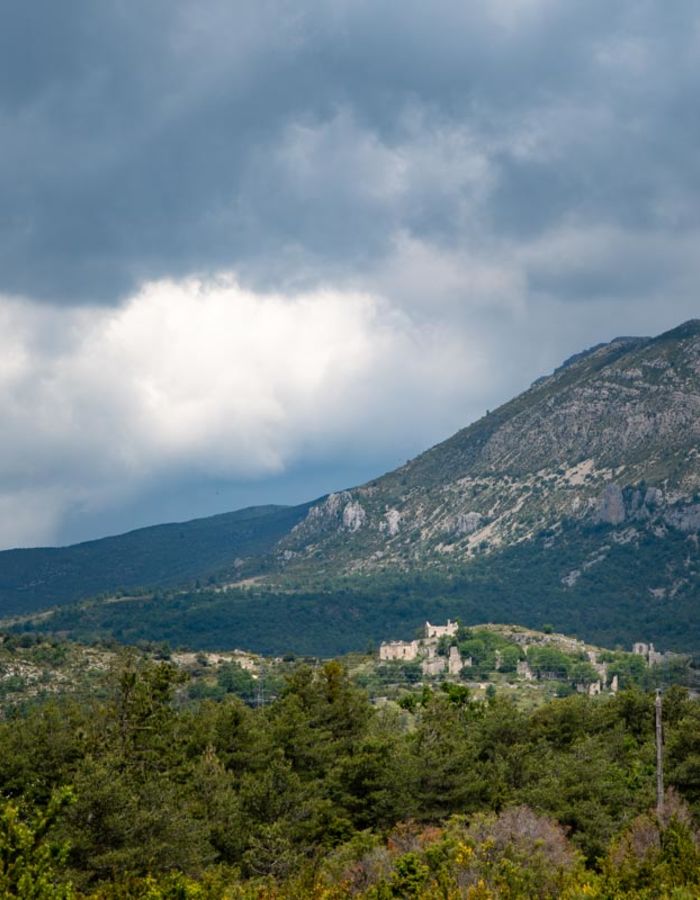
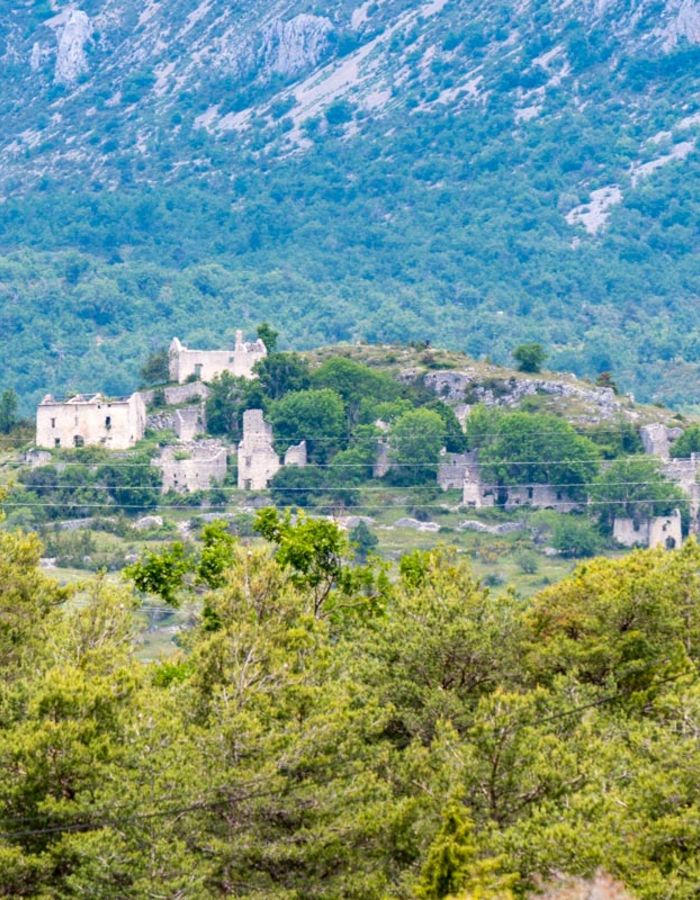
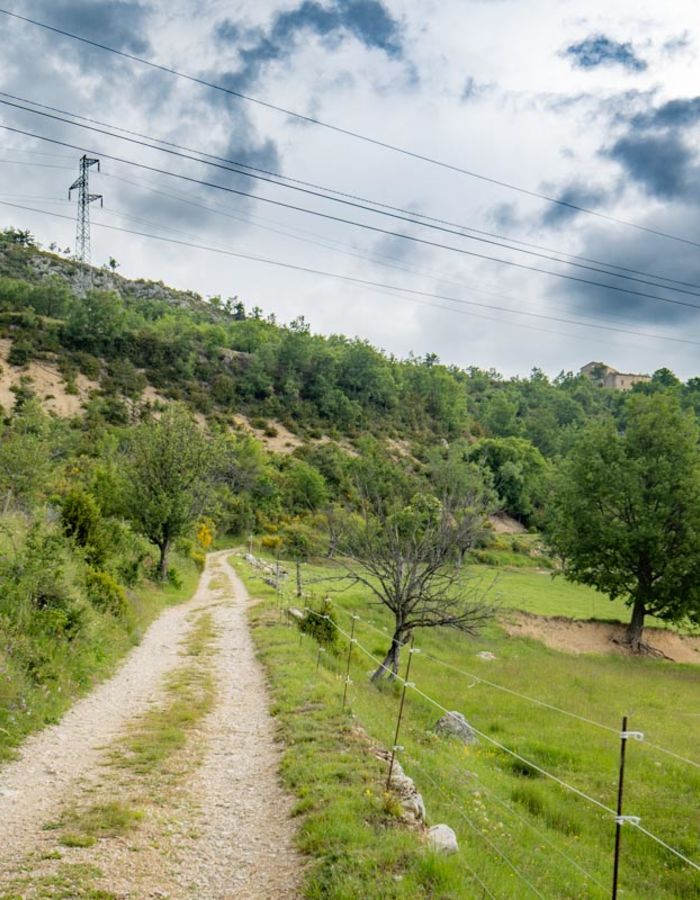
In the heart of the abandoned village of Châteauneuf-les-Moustiers
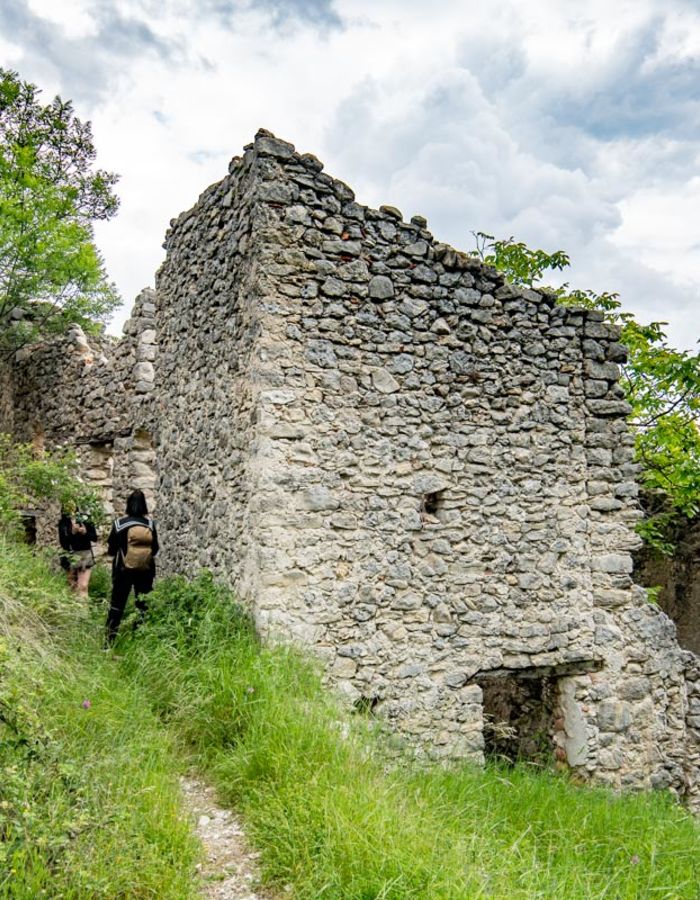
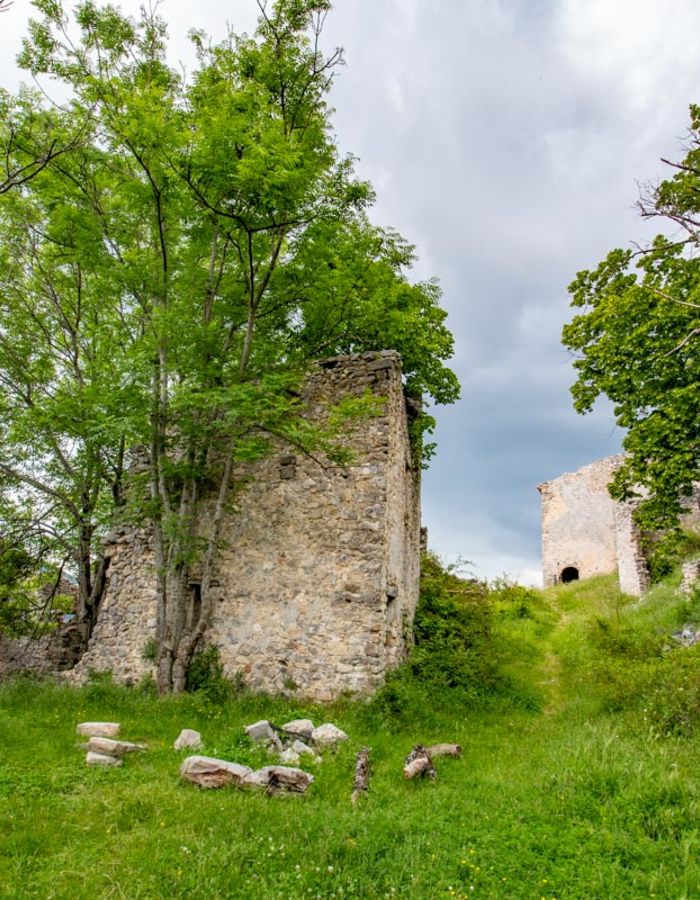
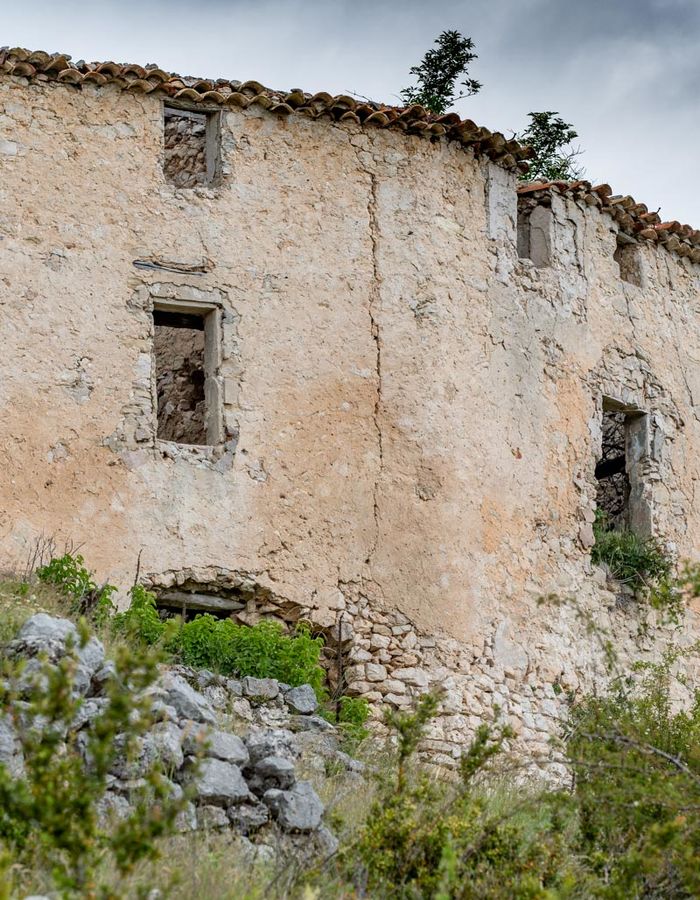
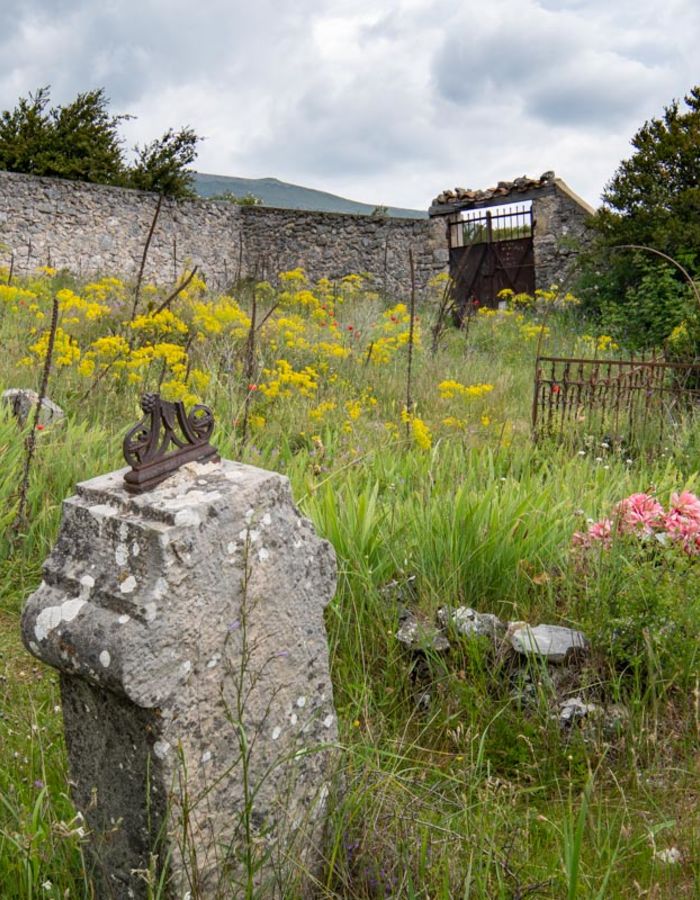
Everything is there, the old cemetery, the crumbling 18th-century church, the walls of the new castle built in the 14th century, and the ruins of the village at its feet. Of course, it takes a bit of imagination, but the memory of life present here for centuries has not completely left the place. The tombstones on which names slowly fade, the carved stone, the houses, all bear witness, whispering their stories to those who are willing to take the time to listen.
From the cemetery, we head towards the ruined church of Saint-Pons, whose apse has been in precarious condition since its consolidation in 2012. A first church, of which almost nothing remains, is mentioned in the confirmation bull of the churches belonging to the Abbey of Montmajour in 1204.
Through a tragic anecdote recorded in 1819, let us briefly immerse ourselves in the life of the village of Châteauneuf-les-Moustiers. This anecdote is found in an excerpt from the "Treatise on Medical Geography and Statistics, and Endemic Diseases: Including Medical Meteorology and Geology, Statistical Laws of Population and Mortality, Geographic Distribution of Diseases, and Comparative Pathology of Human Races." Volume 1 - Jean-Christian-Marc Boudin - 1857.
"In the department of Basses-Alpes, there is a village called Châteauneuf, situated at the summit and at the end of one of the first mountains of the Alps, which forms an amphitheater over Moustiers. It consists of fourteen houses, joined to the presbytery and the parish church, on a hill cut by the angles of two other mountains, one to the east, the other to the west. The interval that separates the village from the eastern mountain is so narrow and deep that its appearance is terrifying. 105 dwellings are scattered in hamlets, almost all on the slope of the eastern mountain, forming a population of 500 souls.
On July 11, 1819, a Sunday, Mr. Salomé, the priest of Moustiers and the episcopal commissioner, went to Châteauneuf to install a new rector. Around half-past two, they went in procession from the rectory to the church. The weather was fine, with only a few large clouds. Mass was started by the new rector. A young man of eighteen who had accompanied the priest from Moustiers was singing the epistle when three thunderclaps occurred in rapid succession.
The missal was torn from his hands and torn to pieces; he felt himself tightly embraced by the flame that immediately caught him by the neck. This young man, who had initially screamed loudly, closed his mouth, was thrown down, rolled over the people gathered in the church, all of whom had been knocked down, and was thus thrown out of the door.
The priest was found asphyxiated and unconscious. He was revived, the flame of his surplice extinguished, and he was brought back to life about two hours later. He vomited a lot of blood. He claimed not to have heard the thunder and knew nothing of what was happening. The electric fluid had struck strongly at the upper part of the gold braid of his stole, flowed down to the bottom, removed one of his shoes, which it carried to the end of the church, and broke the metal buckle.
His wounds did not heal until two months later. He had an eschar from several finger-widths on his right shoulder; another extended from the posterior middle part of the same-side arm to the middle and outer part of the forearm; a third deep eschar started from the middle and posterior part of the left arm and went to the middle part of the same-side forearm; a fourth, shallower and less extensive, on the outer side of the lower part of the left thigh; and a fifth on the upper lip to the nose. He suffered from absolute insomnia for nearly two months; his arms were paralyzed, and he suffered from various atmospheric changes.
A young child was taken from its mother's arms and carried six steps away; it was revived only by letting it breathe the fresh air. Everyone had paralyzed legs. The disheveled women presented a horrible spectacle. The church was filled with thick black smoke; objects could only be distinguished by the light of the flames from parts of clothing ignited by lightning. Eight people died on the spot; a nineteen-year-old girl was taken home unconscious; she died the next day, in excruciating pain, judging by her screams, so the number of people who died is 9; the number of injured is 82. The celebrating priest was not hit. All the dogs in the church were found dead in the position they were in.
A woman who was in a hut on the mountain of Barbin, to the west of Châteauneuf, saw three masses of fire fall successively, which seemed to reduce this village to ashes. It appears that lightning first struck the steeple cross, which was found planted in a crevice in a rock, 16 meters away; it then entered the church through a breach it made in the vault, half a meter away from where a bell rope passes; the pulpit was crushed. In the church, there was a hole half a meter in diameter, extending under the foundation of the wall down to the street pavement, and another that went under the foundation of a stable, where five sheep and a mare were found dead. The bells were ringing when lightning struck the church."
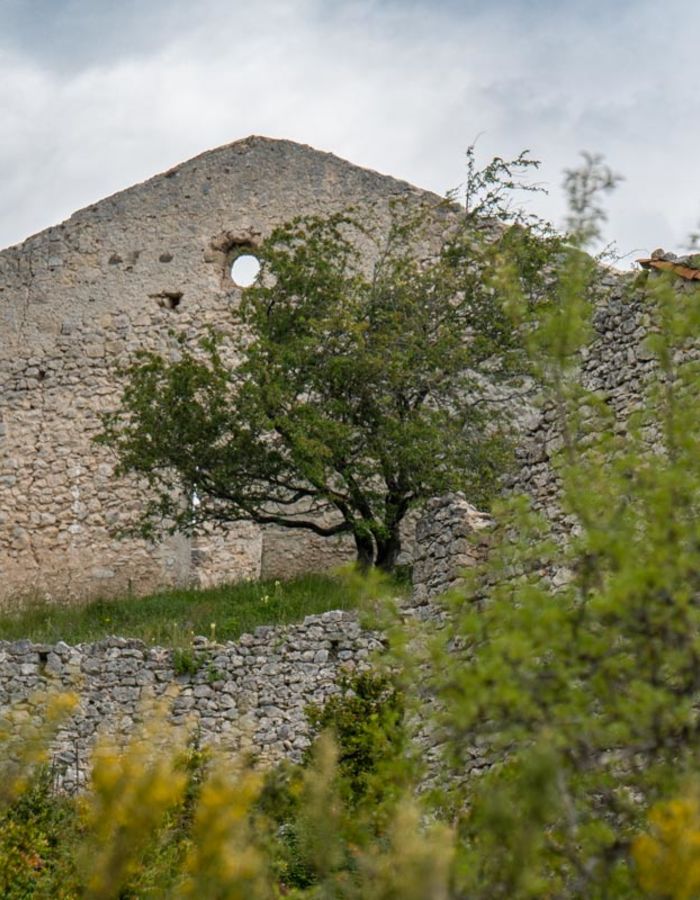
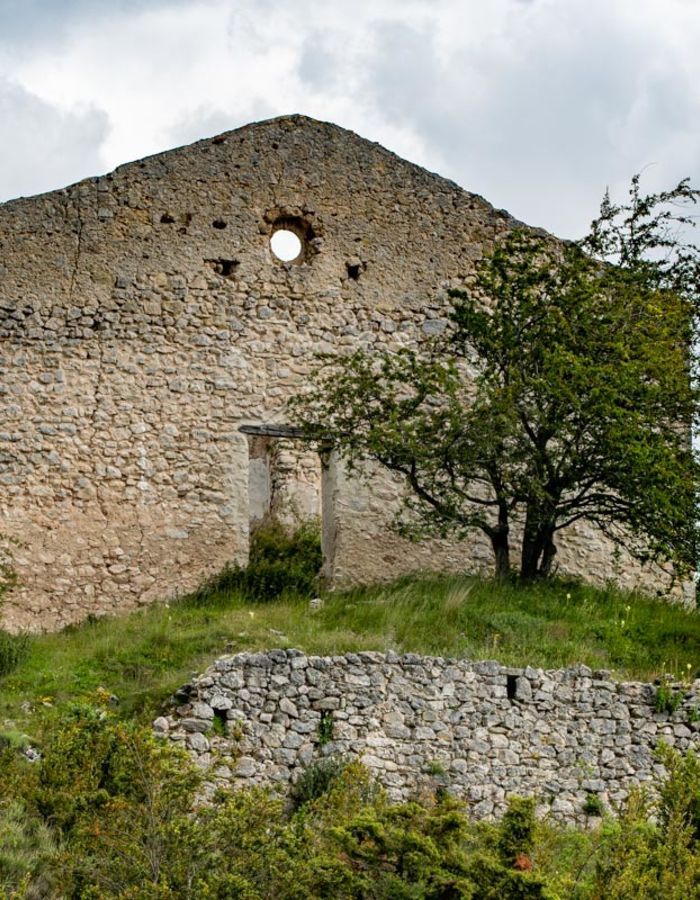
We are now at the highest point. Little or nothing remains of the medieval keep. Despite a threatening sky, we linger on to enjoy the 360° view. A glance at our smartphones reminds us that Châteauneuf-les-Moustiers is still cut off from the world.
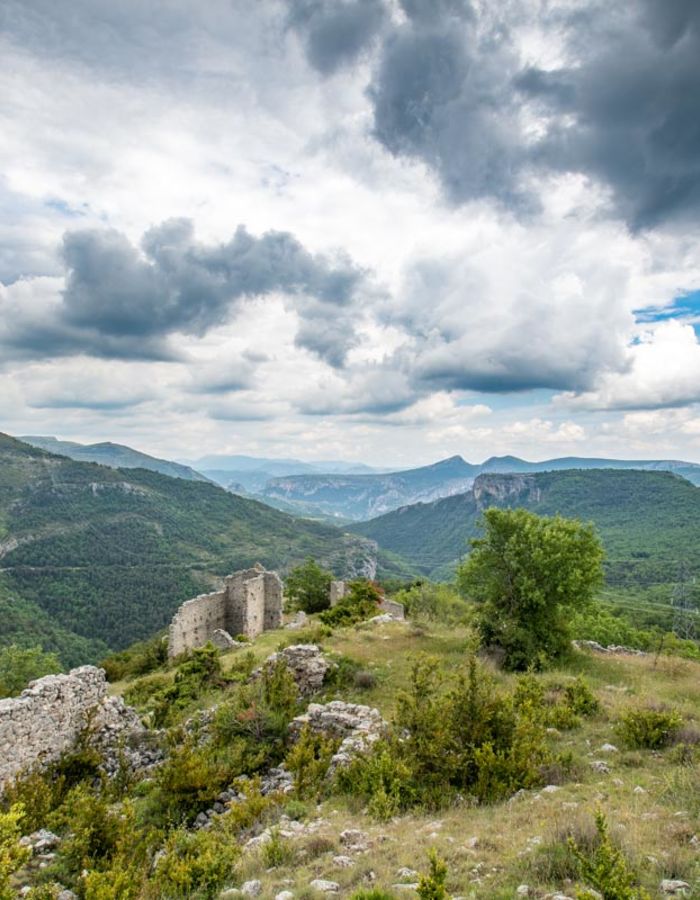
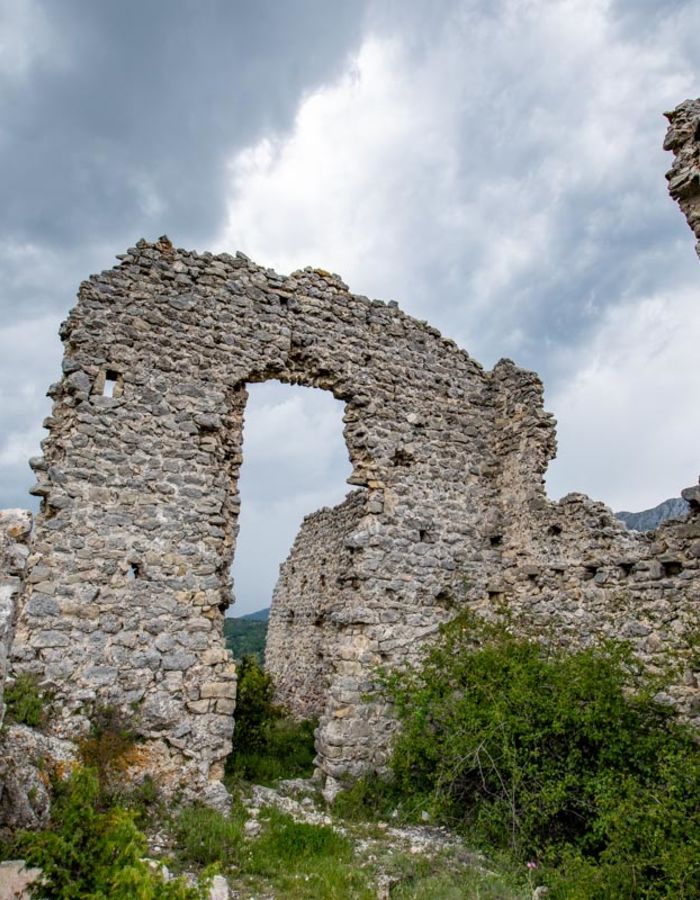
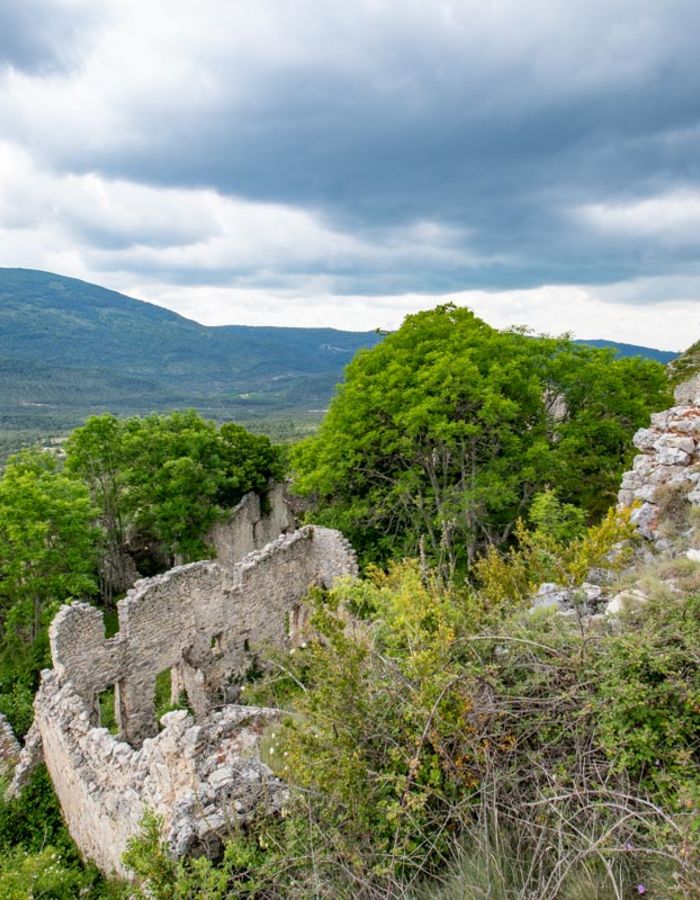
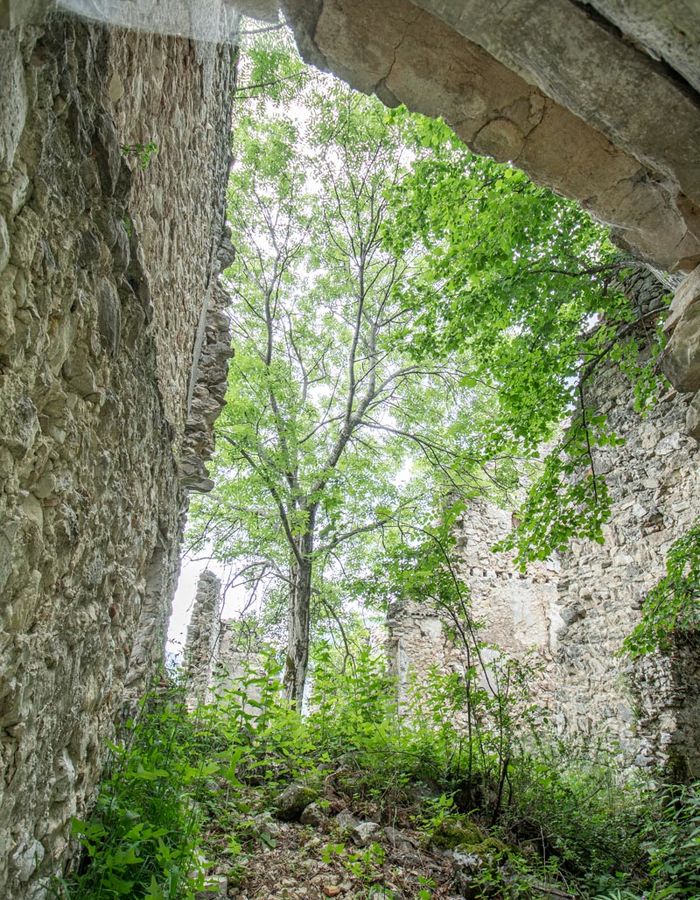
We descend a few steps and find ourselves in what must have been the village's main street. It is narrow and overgrown. Many of the village houses have collapsed, and here and there are traces of a staircase or a chimney that long ago blackened a wall. Trees have grown, reminding us that what we see today will not be there tomorrow. Little by little, time and nature do their work. A few drops of water falling from the sky bring us back to the present. The time has come to return to the car.